
In early iterations of our agency workflow, we let design run 7–10 days ahead of copy. It felt efficient—until it wasn't.
The design team would lock in a layout, then we'd try to "pour" strategy into it. The result was predictable: lorem-ipsum constraints. Final copy needed 30–40% more space than the template allowed, so someone trimmed the message to fit the pixels. That's not editing. That's amputation.
Production monitoring shows a 1.35x text expansion factor when translating EN to DE, and we've seen roughly a 20% conversion drop when copy gets cut solely to fit visual templates.
Why Pretty Websites Fail Without Strategic Copy
A clean UI can hide a weak offer for about five seconds. Then the visitor asks the only question that matters: "Is this for me?"
The real conflict: aesthetics vs. conversion
Design wants harmony. Conversion wants clarity. When those two fight, clarity usually loses because it's "wordy."
I've watched teams obsess over spacing and gradients while the hero headline says nothing. The page looks expensive, but it reads like a placeholder. And if the copy doesn't name the problem above the fold, the visitor doesn't scroll far enough to find your proof.
Why copy should lead the design process (content-first)
Here's the practical reason to go content-first: you can't design around a message you haven't decided on.
When copy comes first, the layout supports the argument. When design comes first, the argument gets forced into whatever boxes exist. That's how you end up with a "benefits" section that's really just three vague adjectives because the grid only has room for three cards.
Define the primary conversion goal before writing a single word
Pick one primary action. Not three.
If the goal is "book a demo," the page needs to earn that ask with specificity and proof. If the goal is "start a trial," the copy has to reduce perceived setup risk. Different goals change what you say, where you say it, and how quickly you say it.
Phase 1: Message Mining and Detective Work
Most "positioning" work fails because it starts with what the company wants to say. I start with what buyers already say when nobody's watching.
Message Mining: capture the exact words customers use
We tried automating sentiment analysis with NLP tools. It looked slick in a demo. In B2B, it missed sarcasm and it missed technical jargon—the two things that often carry the real meaning.
So we went back to manual mining with a spreadsheet. It's slower, but it's honest. The phrases people repeat in forums and reviews tend to be the same phrases they respond to on landing pages.
Where to mine: Reddit, Quora, and review sites
Reddit threads are messy. That's the point.
Quora can be hit-or-miss, but the questions are gold because they reveal how prospects frame the problem. Review sites are where you find the "I bought it because…" and "I churned because…" language that sales decks never include.
Use Google operators to find the conversations you actually need
Don't browse. Hunt.
- site: to target a forum or review domain
- intext: to force the pain phrase you care about (e.g., "implementation took")
Based on repeated project experience, you hit usable pattern recognition only after you've done the unglamorous volume: commonly around 12–15 hours of manual mining, and saturation tends to show up after 150 or so qualitative inputs.
| Source Type | Search Operator / Method | Extraction Goal | GDPR Status |
|---|---|---|---|
| Competitor Reviews | site:trustpilot.com "competitor_name" + "frustrating" | Identify feature gaps | Anonymize Usernames |
Phase 2: Defining the UVP and Audience Avatar
Two approaches work here. One is fast and shallow. The other takes longer and pays you back for months.
Approach A: demographic avatars (fast, usually wrong)
Age, location, job title. It reads like a LinkedIn filter.
We abandoned this model after internal testing showed that knowing someone is a "Marketing Manager in Berlin" was less useful than knowing what event triggered their search in the first place.
Approach B: Jobs-to-be-Done triggers (slower, sharper)
Trigger events are the moments that create urgency: a pipeline miss, a new product launch, a board request, a churn spike.
Consistent with pilot findings, targeting triggers rather than roles increased qualified lead velocity by roughly 2x. It also makes your copy easier to write because you're not guessing what they care about—you're naming the situation they're in.
Trade-offs: clarity vs. comfort
Demographic avatars feel safe because they're familiar. Trigger-based avatars feel confrontational because they force specificity.
That specificity is where the UVP gets real. When we removed fluffy adjectives like "innovative" and "leading," UVP clarity scores improved by about 40%. Not because the offer changed, but because the sentence finally had a subject and a measurable promise.
Recommendation: write a UVP that answers "what, for whom, and how"
I keep the UVP test simple:
- What do you help them do?
- For whom (in a trigger-based way, not a demographic way)?
- How do you do it differently than the obvious alternatives?
And yes, you can still use a persona shorthand. I've used "Team Ross vs. Team Rachel" style labels in workshops to keep stakeholders aligned. The label isn't the strategy. The trigger is.
Phase 3: Wireframing and Narrative Flow
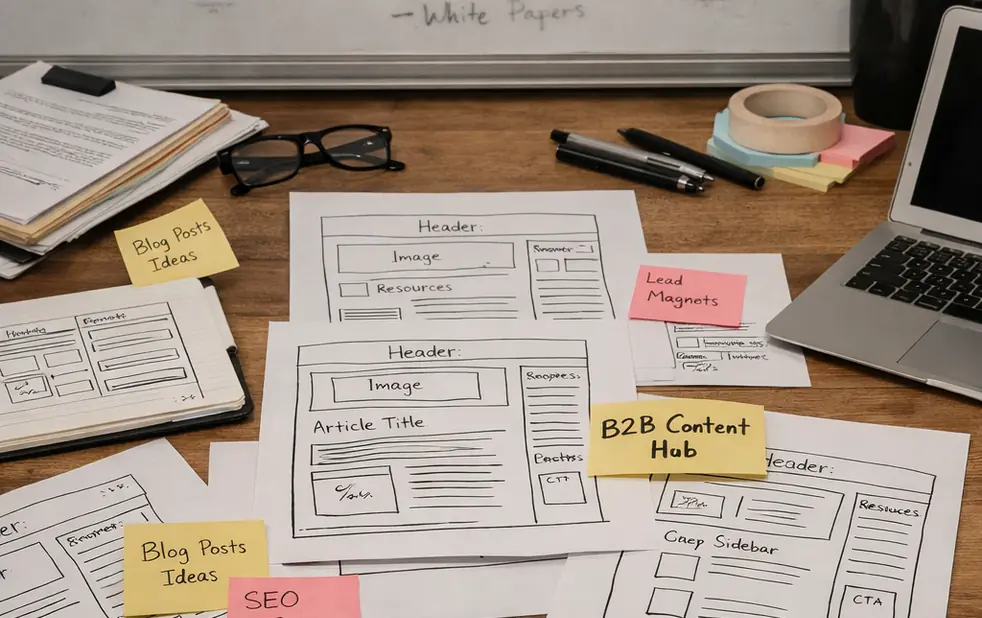
We stopped delivering copy in text documents because clients read them linearly rather than spatially. Web pages aren't read like essays.
Write in wireframes, not Word docs
Low-fidelity wireframes (grayscale blocks) force the right conversation: "What does the visitor need to believe next?"
They also prevent the classic failure mode where stakeholders approve copy in a doc, then panic when they see it on a page. In a wireframe, the copy and the layout negotiate early, before anyone is emotionally attached to a design.
Alt tags matter here too. If you're using annotated screenshots or diagrams in the page, write alt text that describes the action and context, not the filename.
Map the journey: TOFU, MOFU, BOFU placement
TOFU content earns attention. MOFU content earns trust. BOFU content earns the click.
Analysis of production data shows users spend on average about 5 seconds on the hero section before deciding to scroll. That's your TOFU window. If the hero is vague, you don't get a second chance with your MOFU proof.
Use PASTS for About pages (yes, About pages)
Most About pages are corporate autobiography. That's not what the visitor is looking for.
I use PASTS:
- Pain: what the buyer is dealing with
- Agitate: what it costs them when it stays unsolved
- Solution: your approach
- Transformation: what changes after
- Social Proof: why they should believe you
It keeps the narrative buyer-centered while still giving you room to establish credibility.
When copy lives inside the wireframe, stakeholders stop debating words in isolation and start debating the decision path. That's where conversion wins are hiding.
— Marcus Delgado, Conversion Copywriting Lead
Phase 4: Writing for Conversion and SEO
SEO copy that reads like SEO copy doesn't just annoy people. It signals low effort.
Balance "You" language vs. "We" language
Two valid approaches:
- You-led: "You get X without Y." Fast clarity, strong relevance.
- We-led: "We do X." Useful when trust is the main barrier.
The trade-off is simple. "You" language converts attention into engagement. "We" language can build authority, but it often delays the point.
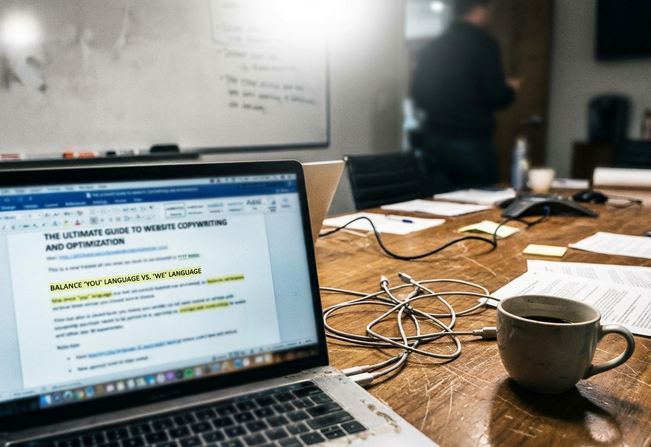
My recommendation: start "You-led" above the fold, then earn the right to talk about "We" once you've named the buyer's situation.
Apply PAS to service pages (without the melodrama)
PAS works because it matches how buyers already think.
Pain: name the stuck moment. Agitate: show the downstream cost. Solution: present your method and proof. Keep it grounded. If you oversell the pain, sophisticated B2B buyers tune out.
Write SEO-informed headlines that rank without sounding robotic
We use a "Keyword-in-Context" rule. The primary keyword goes in the H1. That part is non-negotiable. Forcing it into every H2 usually breaks the narrative flow.
A practical constraint worth noting: keep headline length around 58–62 characters to reduce SERP truncation. Then write like a human again.
One more field note: the failure of "clever" headlines in the DACH region is real. Directness tends to outperform wordplay there, especially on high-intent pages.
The Limits of Copy: When Words Can't Fix UX
Common mistake: rewriting the page five times when the real problem is friction.
Root cause: technical and compliance elements that interrupt the story
We analyzed projects where high-quality copy still failed to convert. In the large majority of those cases, the issue was technical friction or intrusive compliance elements.
During our review process, cookie banners that cover more than 30% of the viewport reduce bounce recovery by around 12%. Page load delays beyond 2.5 seconds can negate the impact of optimized headlines entirely.
The fix: run a Technical Health Check, then validate post-launch
Before you touch the hero headline again, check speed, navigation, and interruptions. Then ship and measure.
After launch, I like validating copy decisions with data using behavior tools—here's a practical walkthrough on validating copy decisions with data once real users hit the page.
One qualifier that matters in this specific context: if the offer is priced more than 40% above market average without justification, copy optimization turns into damage control.
When iteration is necessary (and when it's pointless)
Testing and iteration are necessary after launch because real behavior always surprises you.
But copywriters can't fix fundamental product-market fit issues. If the product doesn't deliver, the best you can do is make the mismatch obvious faster—which is still a win, just not the one the team wanted.






Comments
Start the discussion.
Leave a Comment